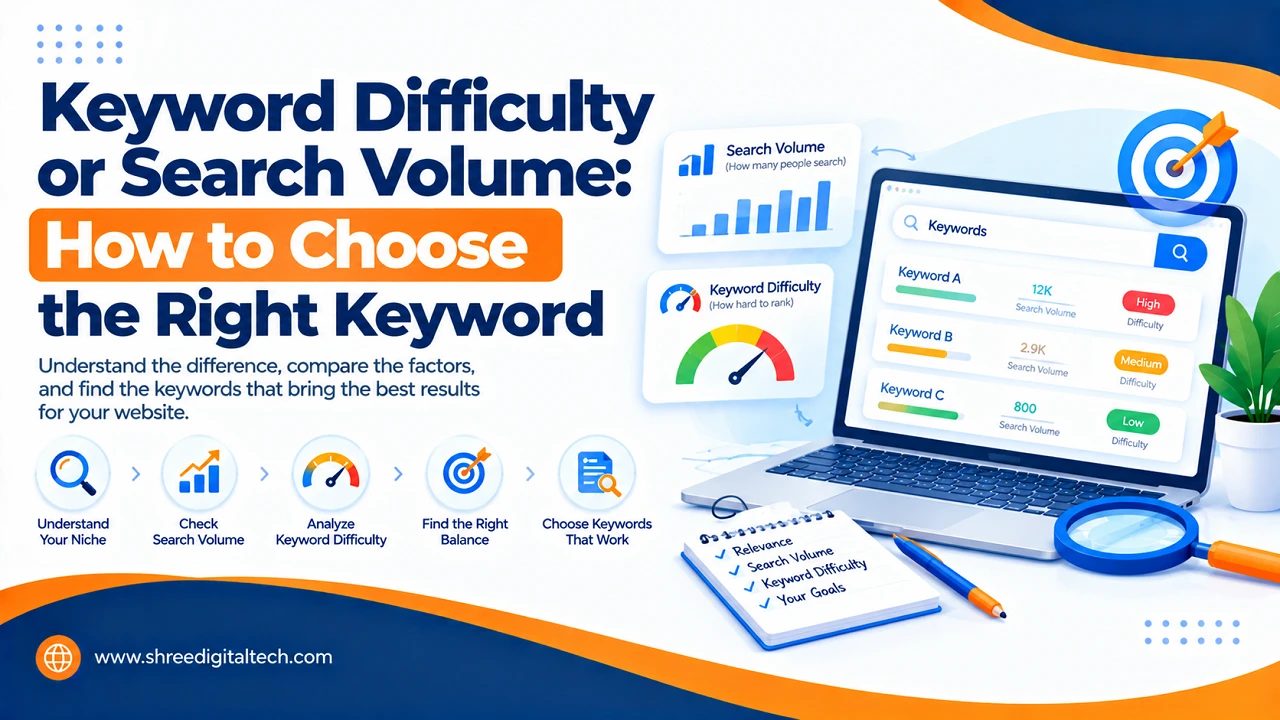
Once you begin keyword research, you’re going to find two figures next to each keyword: search volume and keyword difficulty. There are lots of novices that get confused. If you choose the keyword that gets more traffic, will you be successful? Or the search term that’s simpler to get higher rankings for?
The reality is, you don’t want to just read the one number. You must know the meaning of each of them and then combine these two to select a smart keyword. This guide is very easy to understand.
What Is Search Volume?
Search volume data will inform you about the number of people monthly searching for a keyword on Google. A very basic method for determining whether or not others are interested in a subject.
For example:
- The search volume for “shoes” is enormous, as millions of people are searching for it.
- The number of women who search for running shoes for flat feet is much lower, but they are looking for a specific product.
A lot of them seem like good news, but not necessarily a lot of traffic for you. Many individuals of various types and needs are using many different keywords that are broad and large. It is difficult to create a single page that appeals to them all.
What Is Keyword Difficulty?
The difficulty of the keywords is also known as keyword difficulty or KD, which is a score indicating how difficult it is to rank on the first page of Google for a particular keyword. This score takes into account factors such as:
- How strong the websites are that already rank for that keyword
- The number of backlinks that the pages acquire
- How well the content is good and detailed.
If the KD score is high, then high quality competitors will be ranked and it will take longer and harder to beat them. The lower the KD score, the weaker the competition is, and the newer the site, the better.
For instance ‘digital marketing’ is a very difficult term. But the difficulty for ‘digital marketing tips for small bakeries’ is a bit less, since there aren’t quite as many strong websites targeting that exact phrase.
Also Read: Semantic SEO: How It Works and Why It Matters
The key Difference Between the Two is as Follows
Here’s a way to think of it:
| Metric | What it shows | What it tells you |
| Search volume | Demand | How many people search for it |
| Keyword difficulty | Competition | How hard it is to rank for it |
The search volume is answering the question of “Is this topic popular? The keyword difficulty question is “Can I actually win this? To make a keyword selection, you must have answers to both of these questions.
Why Chasing Only High Search Volume Is Risky
Many people who are new to learning to read music focus on the major numbers. They use keywords that have the highest number of searches and wait for quick traffic. This typically results in what is commonly referred to as a “volume trap.
A volume trap is a keyword that:
- Has a truly high number of searches per month
- Is extremely competitive
- Is targeted by large and popular sites
- Has unclear intent, so it’s hard to write one perfect page for it
It will be difficult for any brand new website to rank for any word that is difficult to rank, such as “shoes” or “SEO” even if the content is amazing. Those results are already dominated by big brands and old websites.
Why Only Chasing Low Difficulty Is Not Enough Either
However, choosing a keyword for its perceived “ease” is also a wrong choice. For some keywords, it might be because very few people are searching for them or because it doesn’t relate to your business.
Before choosing a low-difficulty keyword, you should ask yourself:
- Does my audience actually care about this topic?
- Will the right visitors visit this website because of this keyword?
- Would it make sense for my website?
It is unproductive to pursue a keyword that has no value to your website if it is too competitive.
Also Read: How to Find and Fix Keyword Cannibalization Issues
Search Intent Matters Too
Search intent refers to the intent behind a search; the actual meaning behind the keyword. There are four patterns of common occurrence:
- Informational – the individual wants to learn something (example: “what is keyword research”)
- Informational – the person intends to get more information on a particular brand or webpage
- Commercial – person is considering buying something (example: “best SEO tools”)
- Transactional – the person is ready to buy or take action right now
Even a keyword that is “high volume” and “low competition” can fail if you do not have the right page for your searcher. So make sure you always do some due diligence before you write your content.
How to Choose the Right Keyword: A Simple Framework
Follow this basic checklist when choosing any keyword:
- Does it have enough search volume? I suppose there should be a large number of people looking for it to justify writing the page.
- Is the difficulty realistic for my website? For new sites, it is important to begin with lower-competition keywords.
- Is the search intent clear? Make sure you know what type of content the searcher wants.
- Does it fit my niche? The keyword should be related to what your website actually is offering.
A good keyword typically possesses: good volume, reasonable competition, intent and fit.
A Simple Example
Suppose that you have a small fitness coaching website.
- Bad choice: fitness trainer — has a lot of volume, lots more competition, can be very difficult for a small site to rank.
- Better choice: “personal fitness trainer for beginners at home” — lower volume with much easier to rank but the traffic is the right kind.
The second statement might attract fewer people to your site, however they are more inclined to be actual customers.
Also Read: How to Audit Internal Links on a Website
Final Thoughts
Keyword Difficulty and Search Volume are not opposite sides of the same coin, but allies. Search volume is an indicator of demand. The keyword difficulty is a measure of how difficult the fight will be. And search intent will tell you what content to create.
Don’t ask which keyword has more searches, ask which keyword can I realistically rank for and will it attract the right traffic? This attitude will enable you to steadily grow your site without chasing after the numbers that will never convert to traffic.
FAQs
1. What is the difference between keyword difficulty and search volume?
The number of people who search a keyword in a month is known as search volume. The keyword difficulty is a measure of the difficulty of ranking for this keyword. One is a display of demand and the other is a display of competition.
2. Should I choose keywords with high search volume or low difficulty?
Neither one alone. The ideal keywords are those that have enough search volume but also aren’t too competitive.
3. Is high search volume always a good thing?
Not always. The more popular the keywords the more generic and competitive they will be. Usually when new websites are created, they tackle these keywords, but even with quality content they are unable to rank for these keywords.
4. Is low keyword difficulty always good?
Not always. There are also keywords that aren’t necessarily high-difficulty but that have little search volume or are not a good fit for your audience. A keyword that’s easy to rank for AND useful to your business.
5. How to pick the right keyword for beginners?
Use keywords that have a realistic level of difficulty, good search volume, clear intent and a strong connection to your site’s topic. Don’t go for too general and highly competitive keywords first.
6. What is a “volume trap” in keyword research?
A volume trap is a keyword that has a lot of volume, but has high competition and a low intent. It is easy to waste time chasing these keywords, as new sites don’t generally attain high rankings with these keywords.