If you have a website, you may have heard from your SEO team or marketing tool talk about “search visibility.” But why should you care about it and what does it actually mean? Search visibility describes how likely it is for your website to appear in search results when people are searching for topics, products or services that your website covers. In simple terms , the more you show up in search results , the more likely you are to be seen by potential site visitors . It also gives you an idea of how your SEO efforts perform against the competition. In this guide, we’ll explain what search visibility is, how to measure it, and why it matters for the growth and online presence of your website.
What is Search Visibility?
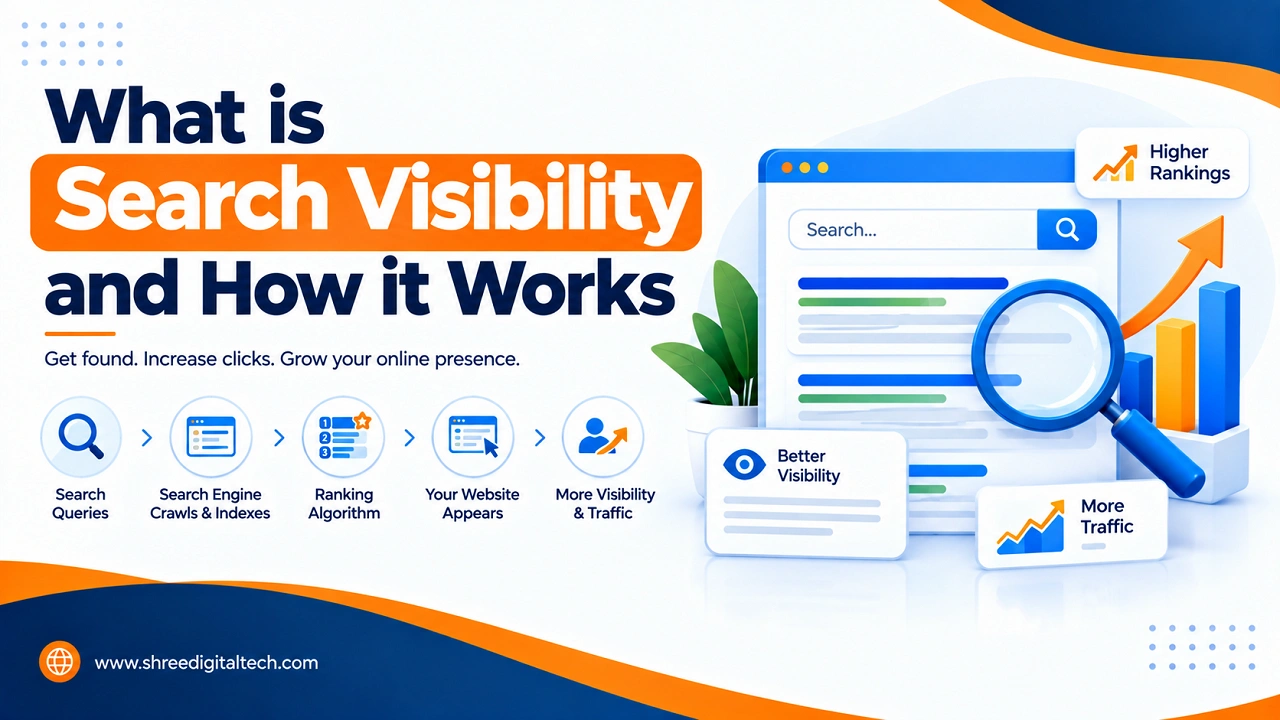
Search visibility is a measure of how often your website shows up in the search results for topics related to your business. This is not about one keyword. “It’s a combined score that looks at all the keywords you care about and tells you how discoverable your site is overall.”
Here’s an easy way to imagine it. Picture 100 people looking for the same thing on Google. If your site is in front of 40 of them, then you have 40% visibility for that search. If it never shows up, your visibility is 0%.
The more visible your presence in search results, the more opportunities you have to be seen, clicked and remembered by potential customers. If you’ve got great content but your site is not very visible, it’s basically invisible.
How Is the Search Visibility Score Calculated
Different tools calculate this score in slightly different ways but the idea is the same everywhere. The two things that matter most are the number of people searching for that keyword and where you are ranked.
What matters most is the rank. A website that ranks in position 1 or 2 is seen (and clicked) by a lot more people than a site sitting in position 15. The majority of tools only count keywords that rank within the top 20 or top 30 positions. Anything below that is usually a zero because very few people go that far down.
Search volume adds some weight. A keyword searched by 50,000 people a month is more important than a keyword searched by 50 people. Ranking well on a high volume keyword will boost your overall score much more than ranking well on a keyword that nobody searches for.
Clicks are the real value. Other tools take this one step further and actually estimate the number of clicks a ranking position earns based on click through rate data. Position 1 may get almost 30% of clicks, while position 10 may get less than 2%. Then that click estimate is compared to the total possible clicks for that keyword, giving you a percentage; your visibility score.
In short, a higher visibility score means that you rank higher for more valuable keywords with a higher search volume.
Also Read: Why Have My Google Rankings Dropped? 9 Real Reasons (And How to Fix Each One)
Traffic and Search Visibility
People think traffic is visibility, but they are not the same thing. It may be possible to see. It shows you how many people could potentially see your website based on your ranking. The outcome is traffic. It tells you how many people actually clicked through and came to your site.
You can be very visible but if your page titles and descriptions are boring, nobody will want to click on them and you will get weak traffic. Or you can have moderate visibility and great traffic if you rank for the exact right high-intent keywords. It’s best for both numbers to go up at the same time. That way, you can see that your SEO work is actually paying off.
Why Your Search Visibility Could Fall
If your visibility score drops all of a sudden, you should look into it, but it doesn’t always mean something is wrong. Common causes include:
- Google algorithm updates – Google frequently changes its ranking systems. A big update can change rankings for many websites at once.
- Technical problems – A blocked page, a misplaced “noindex” tag or a server error can cause Google to silently drop pages from its index.
- Competitors getting better – Rankings are relative. If a competitor creates better content or receives more backlinks, they can push your pages down, even if you haven’t done anything wrong.
- Seasonal changes – Some industries naturally have less search interest at certain times of the year, which can temporarily lower visibility.
- AI-generated answers – More and more queries are now being directly answered by AI tools such as Google’s AI Overviews, ChatGPT and Perplexity. But if your regular rankings are unchanged, you’re not getting picked as a source for these AI answers, so your visibility declines in that space.
Increase Your Search Visibility
- Create material that actually fulfils users’ needs rather than simply mentioning the keyword.
- Target long-tail keywords, which are typically easier to rank for and bring in visitors who already know what they want.
- Fix technical issues on a regular basis, such as broken links, slow pages, and missing sitemaps.
- Get quality backlinks from relevant, authoritative websites.
- Use internal links to help users and search engines find your important pages.
- Regularly check your score using a rank tracking tool so you can catch drops early and know why.
Also Read: How to Find Low-Competition Keywords (2026 Guide)
Summary
One of the most simple ways to assess how well your SEO is working is to look at your search visibility. It tells you whether or not people can find your website when they search for things related to your business. By observing your site, you will learn what makes the site grow or fall and you can improve both the content and the technical aspects of your site. Gradually your site will improve in visibility and ease of access.
Frequently Asked Questions
1. What is search visibility?
It’s a score that tells you how often your website appears in search results for the keywords that matter to your business. The higher the score, the easier you will be found.
2. Is search visibility the same as rank?
No. Ranking is your position for one keyword. Search visibility is your ranking for many keywords, weighted for how popular they are, into one overall score.
3. What is a good score for search visibility?
There’s no one number that counts as “good.” It is based on your industry, the number of keywords you are tracking and your competition. The real goal is gradual improvement over time and not to hit one exact number.
4. My rankings look stable but why is my search visibility dropping?
This may happen when AI-generated responses are appearing instead of regular search results, or when your click-through rate is dropping even when your position hasn’t shifted much. It is worth checking traditional rankings and AI visibility separately.
5. How can I check my website’s search visibility?
Begin with the free data from Google Search Console on keywords and clicks. To achieve a full score for many keywords, use a rank tracking tool that automatically calculates and updates your visibility score.
6. Is more search visibility always equal to more traffic?
Not all the time. Visibility means potential exposure, traffic means actual visits. If your titles and descriptions aren’t attractive, people may come across your site in the search results, but they won’t click through.