When you use an SEO tool, you may have seen a number next to each keyword. This number is called “Keyword Difficulty” or “KD.” This number will give you an idea of how hard / easy it will be to rank your website on the first page of google for that keyword. In this guide, we’ll tell you exactly what keyword difficulty really means, what affects it and how you can use it the smart way in your SEO strategy. You will also learn how to interpret this metric, compare various keywords and choose terms that fit your website’s current SEO strength and goals.
What Is Keyword Difficulty?
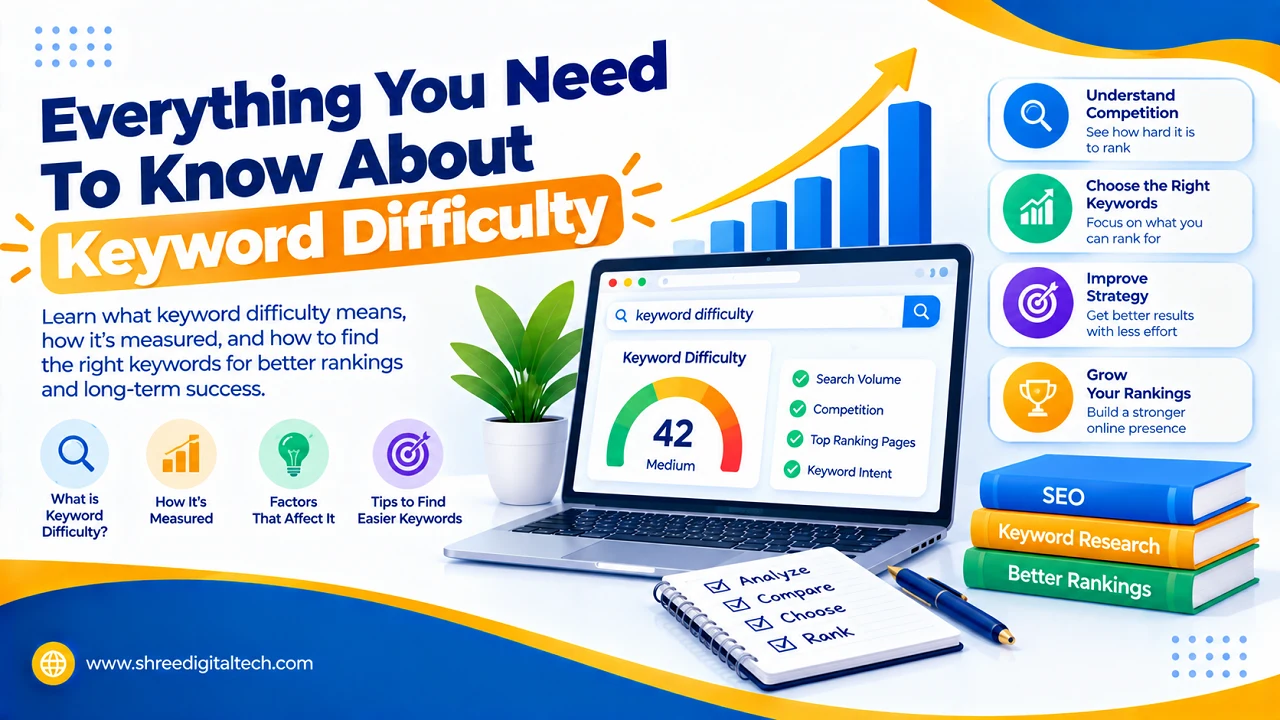
Keyword difficulty is a score, usually between 0 and 100, that estimates the difficulty of competing for a specific search term. A low score means that keyword is easier to rank for, while a high score means that many strong websites are already competing for that spot.
Important to know, this score is not given by Google itself. Tools like Ahrefs, Semrush, Search Atlas and Wincher have their own formulas to calculate it. Therefore, the same keyword might show a different difficulty score on different tools. This is why many experienced SEOs treat keyword difficulty as a ballpark number, not an exact one.
Also Read: Why SEO Is a Long-Term Strategy for Better Results
What Affects Keyword Difficulty?
Several factors determine the difficulty of ranking for a keyword:
- Backlinks: Web pages at the top of search results tend to have lots of quality backlinks to them. More backlinks generally means more authority and more difficulty.
- Domain strength: If a keyword is already ranking on a strong, well known website, it is difficult for a new or small website to compete.
- Search volume: Keywords that get a lot of searches each month are usually more competitive and this raises the difficulty score.
- Search intent: If a keyword is clear about what someone wants (like buying something or needing a quick answer) it can be more competitive because more businesses are going after it.
- SERP features: Things like featured snippets, “People Also Ask” boxes, ads, and local packs can push normal search results down, making it harder to get noticed even if the difficulty score looks low.
- Keyword length: Short and broad keywords like “shoes” are usually very competitive. Longer, more specific keywords, known as long-tail keywords, are often easier to rank for because they match a narrower need.
Also Read: Keyword Mapping Explained: A Complete Beginner’s Guide
Why Keyword Difficulty Matters?
Keyword difficulty is not a random number, it helps you plan your content and spend your time wisely.
1. You learn about your competition. You can see who is already ranking, and judge if you can realistically beat them. If the first page is dominated by large trusted sites, you will have to improve your content and get more backlinks. If smaller or less optimised sites are ranking, that’s a good opportunity for you.
2. It helps you prioritise. Easy keywords can be done fast for simple blog post. Medium keywords could do with better content, some SEO work. Keywords that are hard to rank for will need long-term efforts, strong backlinks, and in-depth content. Knowing the difficulty level helps you know where to spend your time and budget first.
3. It helps you to build a content strategy. See keyword difficulty for tonnes of keywords and find the real opportunities. A combination of easy, medium and tough keywords will help your website grow steadily rather than just chasing terms you might never rank for.
4. It will save time and money. Sometimes a keyword looks surprisingly easy but there’s probably a reason for that – people may prefer to watch videos rather than read articles for that topic. Comparing difficulty scores to actual search results can save you from wasting time on keywords that aren’t going to be worth it.
Does High Difficulty Mean You Should Avoid a Keyword?
Not really. High difficulty keywords are usually high volume and high intent. This means that lots of people are searching for them and they’re ready to take action, like buying a product. Ranking for these can deliver real business value. But only target tough keywords if they are very relevant to your offering, you have the content to back it up, and you’re in it for the long haul and not a quick victory.
Also Read: How to Check Search Intent Before Selecting a Keyword
How to Use Keyword Difficulty Correctly
Rather than just looking at the number, ask yourself these questions before you target any keyword:
- Who is currently ranking and how strong is their content and backlink profile?
- How does my website compare with their website?
- Can I create content that is more useful, deeper, or better researched than what is already ranking?
- Is the keyword what people actually want (their search intent)?
- Are there any SERP features that I can rank for that would decrease my visibility?
Being honest in your answers will give you a much better picture than just looking at one score.
Final Thoughts
Keyword difficulty is a helpful guide on your SEO journey, not a rule book. Choose keywords well by combining it with search volume, search intent and the strength of your own website. Your website will grow steadily over time with a good mix of easy, medium and difficult keywords along with quality content and good backlinks.
FAQs
1. What’s a good keyword difficulty score for beginners?
Most of the time, keywords with a difficulty score between 0 and 30 are the safest place to start for new websites because they need fewer backlinks and less authority to rank.
2. Are all SEO tools showing the same keyword difficulty?
No. Every tool like Ahrefs, Semrush, Search Atlas or Wincher has its own way of calculating difficulty, so the same keyword can have different scores in different tools.
3. Is it hard to rank for a low difficulty keyword?
Yes. Sometimes a low score doesn’t take into consideration things like SERP features, unclear search intent or people liking other content formats like videos, which can still make ranking more difficult.
4. Should I stay away from keywords that are difficult?
Not necessarily. However, if you have a highly relevant, high difficulty keyword that your business is able to invest in great content and backlinks for over time, it can still be worth targeting.
5. Is domain authority a factor in keyword difficulty?
Yes, in an indirect way. Although Google doesn’t officially use “domain authority” as a ranking factor, websites with higher authority and more backlinks tend to rank better for competitive keywords.
6. How often should I check keyword difficulty?
It’s a good idea to recheck difficulty scores every few months, since competition, search volume and SERP layouts can shift over time.