Digital marketing has evolved more in the last 2 years than the last 10 years combined. It’s not just new channels, it’s how decisions are made, how content is created, and how brands connect with people at scale. AI tools, which enable a single marketer to perform tasks that previously required an entire department, are at the core of this change.
AI has made digital marketing faster, smarter and more data-driven, from writing ad copy to predicting which customer is most likely to convert. This guide covers the best AI tools for digital marketers in 2026, categorized by function, along with a simple workflow to combine them and answers to the most common questions marketers ask.
The Revolution of AI in Digital Marketing
The reality is that every brand today is competing for the same limited attention. The same keywords, the same social feeds, the same inbox space. AI helps marketers master drafting, scheduling, testing and reporting at a scale that no human team could manage alone.
AI is useful because it’s fast and accurate. It can process vast amounts of audience and performance data, identify which audience segments respond to which messages, adjust ad bids in real time and personalize content across thousands of touchpoints all at once. Capabilities that were once only available to large enterprise brands are now available to teams of all sizes, and that’s changing who can compete online.
Best AI Tools for SEO
Good SEO tools remove the guesswork from ranking and provide marketers with a clear, data-backed path forward.
| Tool | What It Does |
| Semrush | All-in-one tool for keyword research, competitor analysis, backlink tracking, and AI-powered content scoring |
| Ahrefs | Best for backlink analysis and keyword difficulty; content gap feature shows where competitors outrank you |
| Surfer SEO | Analyzes top-ranking pages and recommends the best content structure, length, and keyword usage |
Top AI Tools for Content Marketing
It used to take hours every week to create and polish content. These tools can reduce that time a lot.
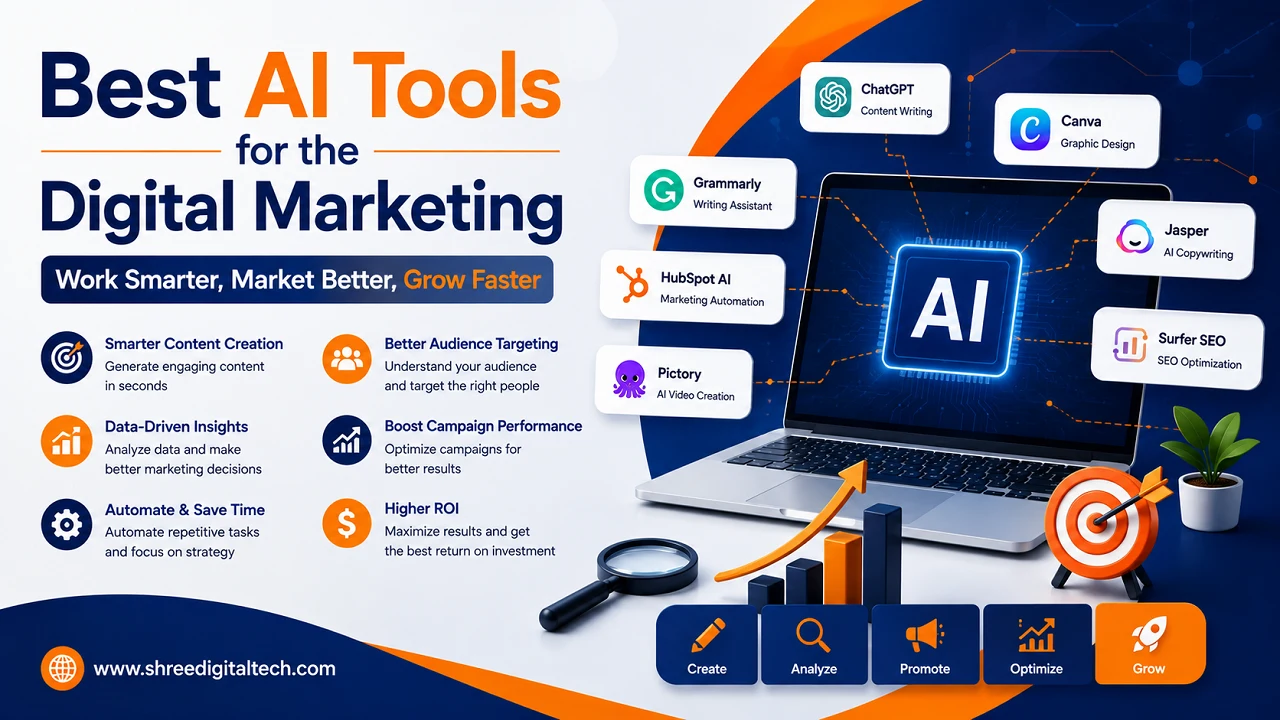
• ChatGPT: Quickly creates outlines, drafts, and repurposes content; quality is very dependent on the prompt.
• Jasper AI: Built for marketing copy like long form blogs, variations of ads and landing pages.
• Grammarly: Checks beyond grammar to include tone, clarity, and brand voice consistency.
Top AI Tools for Social Media Marketing
As volume of content increases, doing it manually on multiple social channels quickly becomes overwhelming. Those tools will reduce that workload significantly.
• Buffer AI: recommends the best times and content ideas to post, based on past performance.
• Hootsuite: Provides AI-generated captions, scheduling and cross-platform analytics.
• Canva AI: Makes professional graphics accessible to non-designers with text-to-image and Magic Design.
Top AI Tools for Email Marketing
Email tools are increasingly using AI to identify the right audience category with the right message.
| Tool | What It Does |
| HubSpot | CRM + AI email automation, behavioural personalization, lead scoring |
| Mailchimp | Build mailing lists, design newsletters and automate targeted campaigns |
| Brevo | Powerful for transactional email and SMS automation with dynamic content blocks |
Top AI Tools for Paid Advertising
Paid ad platforms now rely on machine learning a lot to make sure that spending and targeting are always at their best.
| Tool | What It Does |
| Google Ads AI | AI Automated campaign management based on outcomes, moving away from manual keyword bidding |
| Meta Ads Manager | A single dashboard to set up, run and measure campaigns on Facebook and Instagram |
Top AI Tools for Analytics and Automation
Large marketing datasets are hard to work with manually. They do the hard work for you by finding patterns and automating the repetitive reporting.
• Google Analytics 4: Tracks and measures traffic and engagement across your website.
• HubSpot Operations Hub: Syncs data across tools, cleans CRM records, and triggers workflows based on behaviour.
• Zapier (with AI): Connects thousands of apps and includes AI steps to categorize, summarize, or transform data.
Free AI Tools vs Paid AI Tools
Free versions of tools like ChatGPT, Canva and Mailchimp are enough for individuals or small teams just starting out, giving basic drafts and limited features. For true personalization, deeper automation, and predictive analytics, especially for teams running multiple campaigns at once, paid plans from tools like Semrush, Jasper AI, and HubSpot offer much more value.
An Easy AI Marketing Workflow
The real advantage of AI tools is when you combine them into a repeatable process rather than each one in separate steps.
1. Data Analysis & Audience Segmentation – AI analyses the past customer data to accurately segment the audiences. Thus, manual segmentation is not required.
2. Content Creation – Generative AI is able to take a simple prompt and create a content outline, then help shape it into blog posts, captions or ad copy.
3. Paid Media Optimization – AI eliminates guesswork in ad spend, avoiding budget waste on the wrong audiences.
4. Lead Capture & Nurturing – AI-powered follow-ups connect with leads instantly, delivering personalized messaging to improve the chance of conversion.
5. Performance Monitoring – Regularly analysing analytics and utilizing AI-based knowledge to improve the next content cycle.
Teams that use a mix of tools like ChatGPT for generating ideas, Surfer SEO for optimization, Canva AI for graphics, and HubSpot for automation always outperform teams that use just one tool.
AI’s Limitations in Digital Marketing
AI is powerful, but it is not perfect:
• Accuracy Risks – content produced by AI can contain actual information errors, so human fact-checking is still required.
• Generic Output– AI content can sound flat and fail to stand out without strong prompting and editing.
• Privacy Issues – Personalization at scale requires user data, leading to compliance and privacy challenges.
• Over-Automation – Not every customer interaction should be automated. The human touch can help to build stronger relationships over time.
Can AI Replace Digital Marketing?
No, artificial intelligence is able to automate execution — writing, scheduling, optimizing, reporting — but it can’t understand why a brand exists, what customers really care about, or how to build trust over time. It is not able to make the decisions that define a strong strategy. So, the digital marketer role is evolving, not disappearing, and marketers who can combine a strategy with strong AI skills will be at an advantage over those who don’t evolve.
Final Thoughts
AI has already taken a significant impact on the way digital marketers work with SEO, content creation, paid advertising and social media. The ability to build the proper stack and use each tool efficiently is rapidly evolving from a nice-to-have to a necessary skill. Right now, the winning strategy is straightforward: let human strategy direct the course while AI handles execution.
Frequently Asked Questions (FAQ)
1. Which is the best AI tool for digital marketing?
There’s no one tool that does it all. Semrush and Ahrefs are the leaders in SEO, while ChatGPT and Jasper AI are the most popular for content creation, and HubSpot is a great option for email automation and CRM. The best way is to build a stack where each tool does what it’s truly best at.
2. Best AI tools for digital marketing?
In 2026, some of the most popular AI tools include ChatGPT, Semrush, HubSpot, Canva AI, Jasper AI, and Google Ads AI, each of which plays a role in a different part of the marketing workflow.
3. How does AI play a role in digital marketing?
AI is used for everything from SEO research and content creation to social media management and email personalization and even paid ad optimization, essentially supporting the entire process from awareness to conversion.
4. Can I use AI tools for digital marketing for free?
There are plenty of free, usable versions of tools like ChatGPT, Canva, Buffer, and Mailchimp. But full automation, advanced analytics and deep personalization usually require a paid plan.
5. Will AI replace digital marketers in the future?
No. AI is able to automate execution, but it cannot replace strategic thinking, creativity or human judgment. Marketers who add strong AI skills to their core expertise gain a real advantage.
6. What AI tools are used for social media marketing?
Tools such as Buffer and Hootsuite for scheduling and analytics, Canva AI for visual creation, and Meta Ads Manager for AI-powered paid social campaigns are popular.
7. What are the benefits of employing AI for digital marketing?
Key benefits are speed, scalability and precision. AI allows smaller teams to run campaigns as well as larger ones, but also enables personalization at scale.
8. What skills do I need to use AI tools for marketing?
The key skills marketers need today are prompt engineering, SEO fundamentals, data literacy, content strategy, and the ability to critically evaluate and edit AI output.