In this article
- Why Use AI Tools for Content Creation?
- Best AI Tools for Writing and Blogging
- 1. Jasper AI
- 2. Copy.ai
- 3. Rytr
- 4. ChatGPT
- 5. Gemini
- Best AI Tools for Editing and Grammar
- 6. Grammarly
- Best AI Tools for SEO
- 7. Surfer SEO
- 8. Outranking
- Best AI Tools for Images & Design
- 9. Canva
- Best AI Tools for Video Content Creation
- 10. InVideo
- 11. Synthesia
- 12. Pictory
- Best AI Tools for Audio and Podcast Editing
- 13. Murf
- 14. Descript
- Best AI Tool for Research
- 15. Perplexity
- Quick Steps to Using AI Tools Effectively
- Things to Keep in Mind
- FAQ
Content creation has changed a lot in the last few years. Today, over 75% of marketers are using AI tools in some form and many businesses now use AI to help them write, design and publish content faster. If you’re a blogger, marketer, YouTuber or small business owner, AI tools can save you hours of work every week.
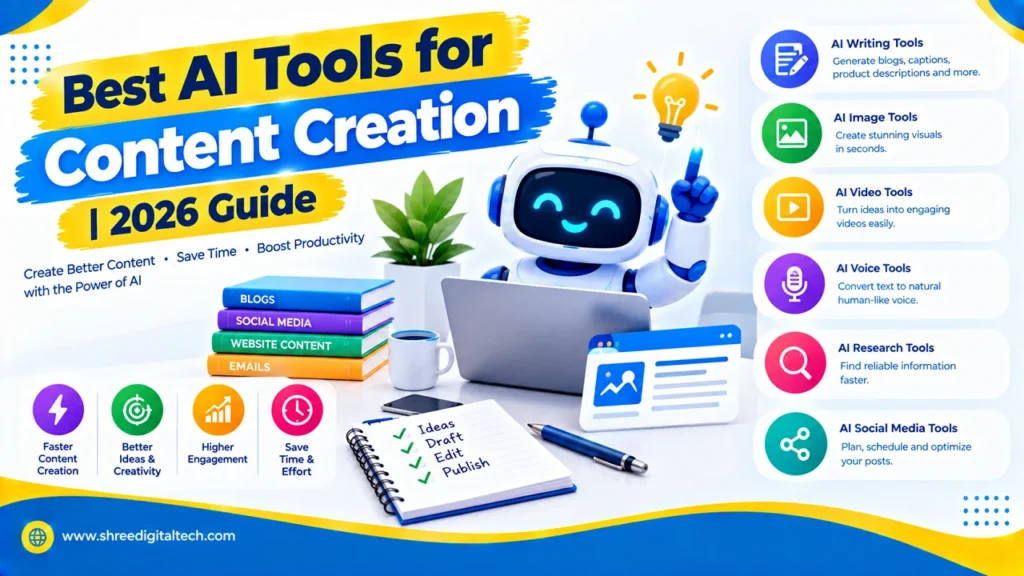
In this guide, we will explore the best AI tools for content creation in 2026 – for writing, SEO, images, video and audio – in simple, easy language.
Why Use AI Tools for Content Creation?
Before we go deeper into the tools, let’s understand why so many creators are switching to AI:
- Saves time – A normal 500-word blog post can take around 4 hours to write by hand. AI tools cut this time down a lot.
- Saves money – Hiring freelance writers can cost you a good amount per article. AI tools reduce this cost.
- Boosts productivity – Ideas, outlines, and first drafts can be ready in seconds.
- Helps with SEO – Many AI tools now give keyword suggestions and content optimization tips.
- Supports different formats – You can create text, images, videos, and voiceovers, all with AI help.
However, AI is not perfect. It can still make mistakes, sound repetitive, or miss the “human touch.” So it’s best to use AI as a helper, not a full replacement for your own creativity.
Also Read: How AI Is Transforming Digital Marketing | Guide 2026
Best AI Tools for Writing and Blogging
1. Jasper AI
Jasper is perfect for writing blog posts quickly. It includes more than 50 templates for blogs, product descriptions, and social media content. You can also adjust the tone of writing to fit your brand.
2. Copy.ai
Copy.ai is more known for social media copywriting. It also helps write marketing emails, blog outlines and ad copy. There’s a free plan too, but the credits are limited.
3. Rytr
You can choose the tone of your content using Rytr — casual, friendly or persuasive. It also supports many languages, which makes it useful for content creators everywhere.
4. ChatGPT
ChatGPT is one of the world’s most popular AI tools. Content creators use it to brainstorm ideas, write drafts and even fix writer’s block. The free version has restrictions but ChatGPT Plus unlocks additional features.
5. Gemini
Google’s Gemini is highly skilled at research, writing and translation. It is good at knowing context and writing clean and human-like text with helpful formatting.
Best AI Tools for Editing and Grammar
6. Grammarly
Grammarly checks your spelling, grammar, and tone in a matter of seconds. It integrates into Google Docs, browsers, and email, making it one of the easiest tools to add into your everyday writing routine. The free plan is pretty good, and the premium version adds style and clarity tips.
Best AI Tools for SEO
7. Surfer SEO
Surfer SEO analyses the pages ranking highest for your keyword and provides you with recommendations on word count, headings and keyword usage. Gives you a live score as you write so you can see if your content is SEO friendly.
8. Outranking
Outranking determines the search intent of content produced by AI briefs. It helps you plan the structure of your article before you even begin writing.
Also Read: Best AI Tools for Digital Marketing | 2026 Guide
Best AI Tools for Images & Design
9. Canva
Canva makes designing graphics easy, even if you’re not a designer. Its background removal and ready-made templates and Magic Write AI feature help you turn plain blog posts into visually appealing content.
Best AI Tools for Video Content Creation
10. InVideo
InVideo is a video creation tool with over 1000 templates. It gives access to stock libraries like Shutterstock which is handy for YouTubers and brands.
11. Synthesia
Synthesia is best known for AI avatar videos. Supports 120+ languages. Used widely for training videos, e-learning content and marketing videos.
12. Pictory
Create short videos from your blog posts or scripts automatically using Pictory. It has the option of adding captions and voiceovers as well, which can be handy if you want to transform written content into a video for platforms like Instagram or Youtube.
Best AI Tools for Audio and Podcast Editing
13. Murf
Murf is a text to speech tool. Enter your script, select a voice, and it creates a natural sounding voice over. Also you can change the tone, pitch and speed.
14. Descript
Editing audio and video is as simple as editing a text document with Descript. You literally delete or edit text in the transcript and the audio/video updates for you automatically. It’s a favourite with podcasters.
Best AI Tool for Research
15. Perplexity
Perplexity is like a smart search engine. It provides clear answers with citations to help content writers quickly research and check facts before publishing.
Quick Steps to Using AI Tools Effectively
- Know your audience – Without this, even the best AI tool won’t produce content that connects with readers.
- Pick the right tool for the job – Some tools are best for writing, others for SEO, video, or design.
- Do keyword research – Use AI tools to find what your audience is actually searching for.
- Let AI assist, not replace – Use AI for ideas, drafts, and edits, but add your own voice and experience.
- Edit and fact-check – Always review AI-written content for accuracy and tone before publishing.
Things to Keep in Mind
AI content tools are powerful but they do have their limits:
- They can sometimes produce generic or repetitive content.
- They may lack real emotional connection or storytelling depth.
- Facts can be wrong sometimes, especially on complex topics.
- Google can detect low-quality AI content, so quality editing is important.
The best results usually come from a mix of AI speed and human creativity.
FAQ
Q1. What is the best AI tool for writing blog posts?
Jasper AI and ChatGPT are two of the most popular blog post writing tools, as they come with templates and are easy to use.
Q2. Is there any free AI tool for creating content?
Yes. All three of them, Grammarly, ChatGPT (basic version), and Copy.ai have free plans, but with limited features or credits.
Q3. What is the best AI tool for SEO content?
Good SEO options are Surfer SEO and Outranking as they give you keyword suggestions and content briefs based on actual search data.
Q4. Can AI tools make videos as well?
Yes. Tools such as InVideo, Synthesia, and Pictory can transform scripts or blog posts into complete videos with captions and voiceovers.
Q5. Will AI ever replace human writers?
No. AI tools are excellent for saving time and creating drafts but for high quality content you still need human creativity, personal experience, and emotional connection.
Q6. Are AI-written articles safe for SEO ranking?
Where AI content can rank well is if it’s well-edited, accurate and really adds value for readers. Publishing raw AI content without editing is a risk and can harm your SEO.
Q7. What is the easiest AI tool for beginners?
Copy.ai and Canva are considered beginner-friendly due to their simple interfaces and pre-made templates.
Ask AI about this article
Get a quick summary or ask follow-up questions.

Akash Yadav
Part of the Shree Digital Tech team, helping businesses in the USA, UK, Canada, Australia, Europe and India grow with SEO, paid media, content and websites.