At some point in creating your company’s online presence, you’ve probably asked yourself this question: should you build a full business website, or would a single landing page do the job? They’re used a lot all the time in marketing conversation but they’re built differently, they behave differently and they’re meant to accomplish very different things. Getting this difference right – before you spend any money on design or development – could save you a lot of wasted effort and help you get better results from your marketing spend.
This guide breaks down what a business website is and what a landing page is, how they are different, and how to decide which one (or both) your business actually needs.
What is a Business Website?
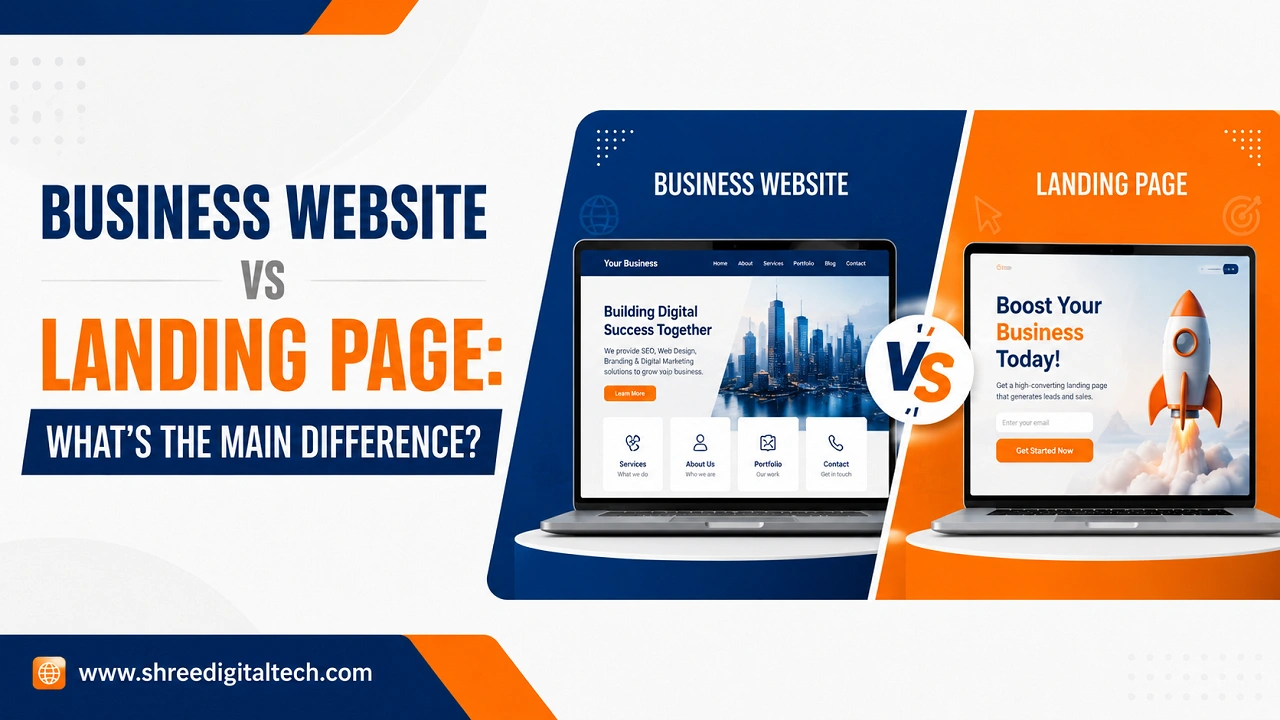
A business website is the digital headquarters of your company, your central, permanent home for everything brand. It’s a series of interlinked pages all living under one domain that together tell the full story of who you are, what you sell, and why someone should trust you.
Typical pages of a business website are:
- Home
- About Us
- Services or Products
- Portfolio or Case Study
- Blog
- Contact Us
A website is an asset for the long run, not a single campaign page. It’s the foundation for your SEO, content marketing and brand-building efforts. People who visit your site can easily switch between pages, read your blog, look at reviews, and eventually get in touch—all without leaving your domain. This freedom of navigation is part of what makes a website useful for gradually building credibility, but it’s also part of what makes it a poor fit for driving one specific action fast.
What is a Landing Page?
A landing page is the almost complete opposite of a website in almost every structural way. It’s a single page focused on a single marketing objective. That’s where visitors usually “land” after clicking a link in an ad, email or social media post—hence the name.
Instead of inviting people to explore, a landing page narrows their options down to one: the call to action (CTA). That CTA might be:
- Requesting a quote
- Consultation or demo appointment
- Downloading an ebook or brochure
- Registering for a webinar or event
- Buying something
Because landing pages are built around a single conversion goal, they typically remove navigation menus, footer links, and anything else that might distract a visitor from taking that one action. And that’s why they usually convert much better than a regular website page when paired with paid ads, email campaigns or product launches.
Landing Page vs Website: What’s the Difference?
Both live on the internet, and both are technically “web pages,” but they are structured differently and play very different roles. So how do they measure up?
1. Objective
There is a website, which is the representation of your entire business, a complete digital platform to inform, build trust and promote long-term growth. A landing page is for a single campaign and a single outcome. Your website creates the brand Your landing page drives an action.
2. Navigation
Websites are made for discovery. They have menus, internal links, footers, multiple entry points, so visitors can browse at their own pace and find whatever they are looking for. Landing pages intentionally reduce or remove this. Menus, outbound links, and anything that could possibly take a visitor away from the CTA are usually removed so that attention remains glued to the one goal.
3. Design and Content
A website design is the entire range of your brand – different layouts, sections and content types on many pages. The landing page design is simple and focused: one strong headline, one supporting subheading, some proof (testimonials, visuals, trust badges) and a clear CTA button. Everything on a landing page exists to get the visitor to take that one action. Nothing is there “just for information.”
4. Time Length
Websites are generally fixtures that last, grow with your business, and remain a consistent point of contact for years. Landing pages, however, tend to be short lived. They are created for a specific campaign, promotion or event and when that campaign is over the page might be archived, changed or removed entirely.
5. Focus On Your Audience
A website should be useful for many people who want to learn more about your business, no matter how they got there. A landing page is built for a specific, laser-targeted audience: people coming from a specific ad, email or campaign who have some context about the offer before they click through.
6. The Impact on SEO
Websites have a lot of pages and ongoing content (blogs, service pages, case studies) so they have much more surface area to rank for a variety of keywords over time. Landing pages can be optimised around specific campaign keywords, but their single-page, conversion-first structure generally gives them less long-term SEO weight than a full site. That said, a well-optimized landing page can still do well for a specific, high-intent search term related to its offer.
When to Use a Website?
If your objectives are long-term exposure, brand trustworthiness, and delivering complete information, then a business website is the right investment. If you want to do any of the following, it is essential:
- Establish your brand’s trust and authority in the industry
- Rank organically on search engines for multiple keywords
- Offer a complete range of services/products
- Publish blog posts and educational content
- Offer testimonials, case studies, and social proof
- Give potential customers a place to research you thoroughly before buying
If you’re a B2B company, a service provider with multiple offerings, or any business that is investing in SEO and content marketing, a website is not optional. It is the foundation for everything else.
When Should You Use a Landing Page?
A landing page earns its place when you need to drive one specific action, fast, from a specific audience segment. It works particularly well for:
- Google Ads or Meta Ads campaigns
- Product launches
- Seasonal or limited-time promotions
- Webinar and event registrations
- Lead-generation offers like eBook downloads or free trials
Because a landing page removes distractions and speaks directly to the intent behind the click, it tends to convert at a noticeably higher rate than sending that same traffic to a general homepage.
Can a Business Use Both?
It’s not really a case of one or the other. Most businesses that get great results online use both assets together, each doing what it does best.
Digital marketing agency, for example. The website has it all — services, team, blog, portfolio, contact info. At the same time, it might have dedicated landing pages for specific campaigns — like “SEO Services for Manufacturing Companies” or “Website Development for Startups.” The website gains long-term authority and organic traffic, while landing pages convert traffic from specific, time-bound campaigns.
This combo allows a business to do two things at the same time – build trust over time through its website and generate maximum conversions from every ad rupee or dollar spent through tightly focused landing pages.
Common Mistakes to Avoid
When companies combine these two tools, there are a few common mistakes that pop up:
• Redirecting ad traffic to home page. Visitors click on a specific ad expecting a page about that specific offer. When you arrive at a general homepage with irrelevant links, confusion a drop off usually occur and conversion rates suffer.
• Not visiting the website at all. Landing pages are good for lead generation, but they don’t build long-term credibility and they don’t help much with organic search visibility. If you only have landing pages, you don’t even have a real website behind them and so there is no permanent digital home for customers to return to.
• One asset serving as a proxy for another asset. Too much navigation and Too many messages on a landing page stop converting well. A website page aiming to be a landing page for an ad campaign often performs poorly because it’s too broad.
Final Thoughts
The main difference between a business website and a landing page is their purpose and structure. It provides a more complete online experience with multiple pages, navigation options and types of information. A landing page is more specific and typically centers around one campaign, offer, or conversion goal.
Websites can help you build credibility, add more detail, help with SEO, and create an online presence in the long run. A landing page can help businesses keep visitors focused when they want one particular action.
The right approach depends on your business goals, audience, content needs, and marketing activities. It’s possible to develop a more complete online strategy in many cases by employing both.
FAQs
1. What’s the Difference between Website vs Landing Page?
A website is a collection of many interlinked pages that provides complete business information. A landing page is a single page with a single purpose like generating leads or promoting an offer.
2. Is it possible to use a landing page instead of a website?
Yes, a landing page can work for a single product, service or short-term campaign. But a full website will give more information, credibility and long-term SEO opportunities.
3. What is another name for a landing page?
Other names for a landing page are squeeze page, lead capture page or campaign page. The proper term usually depends on what it is for.
4. Do I need to have a separate domain for my landing page?
No, you don’t need to have a dedicated domain. You can host a landing page on your existing website, either on a specific URL path or subdomain.
5. Are landing pages good for SEO?
Yes, a landing page can be optimized for a specific keyword to rank for it. But it usually has a more specific SEO focus than a full website.
6. How many landing pages does a business need?
A company doesn’t have to have a certain number of landing pages. The number depends on its services, products, campaigns, locations and target audiences.